
ArticlesArticleOctober 11, 2026
What Is a Trailer Axle?
The trailer axle is one of the most important components of the chassis and wheel assembly of trailers and semi-trailers.
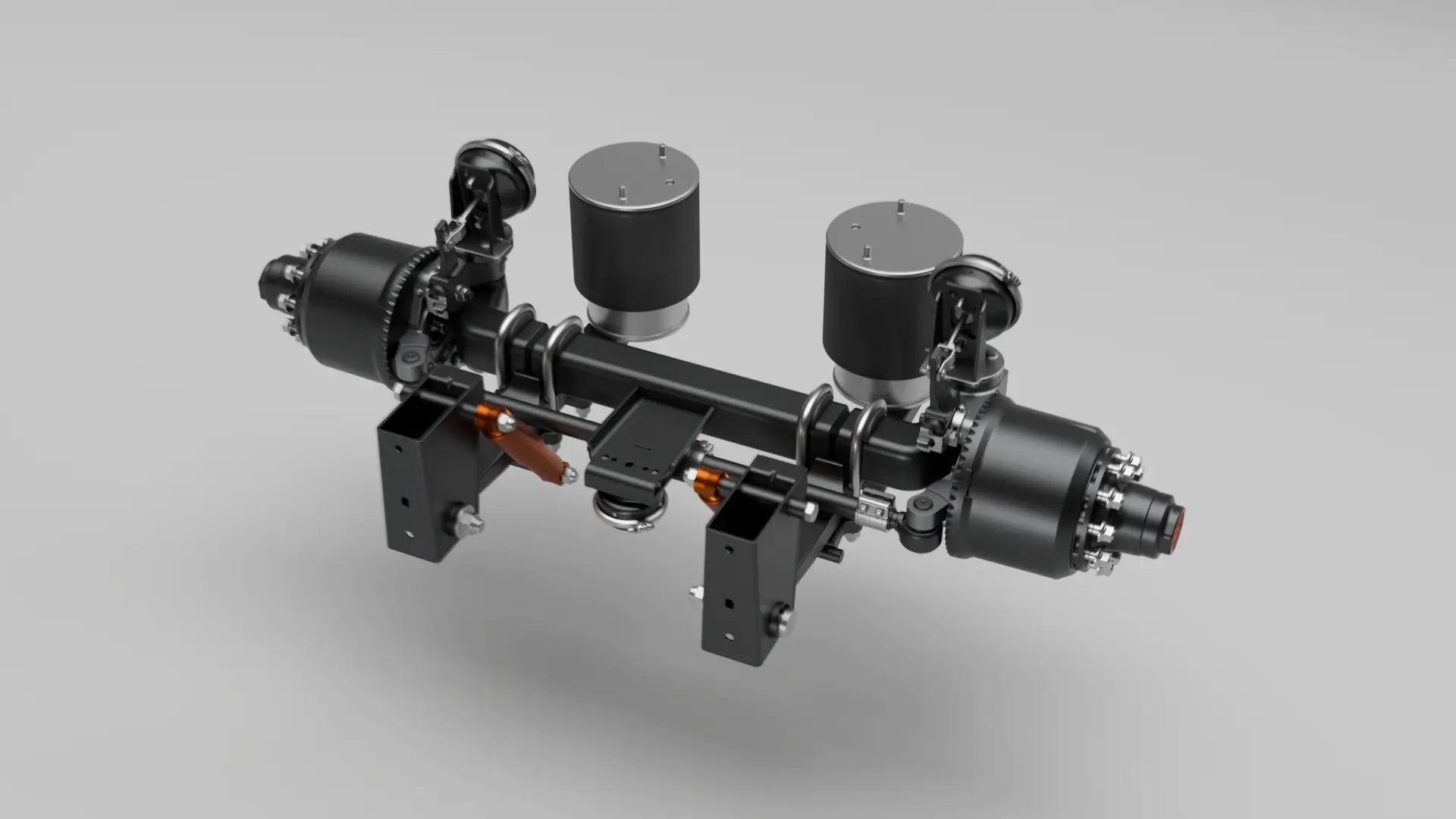
The trailer axle is one of the most important components of the chassis and wheel assembly of trailers and semi-trailers. It carries and transmits load, supports the wheel assembly, interfaces with the braking and suspension systems, and maintains correct running geometry. Nevertheless, a "trailer axle" is not merely a simple metal part, and its types cannot be classified by a single criterion. An axle may be defined by its braking system (disc or drum), its suspension system (Intra or spring-type), and its function (fixed or steerable). The official catalogue of Mehvar Sazan Jahan Spoota (RST) likewise classifies its products on this basis. This article examines the definition of the trailer axle, its functions, components, types, capacity, technical specifications, steerable axles, the Mount arrangement, and guidance on selection and maintenance. It then presents examples of products from Mehvar Sazan Jahan Spoota (RST).
What Is a Trailer Axle?
A trailer axle is a structural and mechanical assembly that supports the wheels of a trailer and transmits the load received from the chassis and suspension system to the wheel assembly and, ultimately, to the road surface. Components such as the hub, bearing, brake assembly, and suspension attachment parts are also associated with the axle. Depending on their design, trailer axles can be manufactured for different capacities, braking systems, suspension types, and wheel and axle arrangements. For example, SAF-HOLLAND, for a family of its standard axles, publishes technical specifications such as a capacity of 8 to 12 tonnes, track width, brake type, bearing type, and wheel attachment type. Accordingly, when defining the trailer axle, a distinction must be made between the axle itself and the complete axle assembly, because the final performance results from the combined action of the axle, wheel, hub, bearing, brake, and suspension system.
What Is the Function of a Trailer Axle?
- Load bearing: The weight of the chassis, equipment, and trailer load is transmitted to the axle assembly through the suspension system. For this reason, axle capacity must be consistent with the permissible axle load and the trailer design.
- Supporting the wheel assembly: The axle provides the mounting location and connection for components such as the spindle, hub, and bearing, and allows controlled rotation of the wheels.
- Interface with the braking system: The braking system is connected to the axle and wheel assembly. Trailer axles may be equipped with drum or disc brake systems.
- Interface with the suspension system: The axle is directly connected to the trailer's suspension system, and the design of its attachment points must be compatible with the suspension type. Depending on their design, trailer axles may be used with mechanical or air suspension systems.
- Maintaining geometry and running stability: The condition of the axle and suspension, and the alignment of the wheels, affect the trailer's running behavior and tire wear. For this reason, correct alignment of trailer axles is an important part of servicing and maintenance. In its alignment instructions, Hendrickson emphasizes inspecting the condition of the axle, suspension system, tires, and bearing play before any adjustments are made.
What Is the Difference Between a Trailer Axle and a Truck Drive Axle?
One common mistake is to treat a trailer axle as equivalent to a truck drive axle. On a conventional trailer, the non-driven axles have the primary role of carrying load and supporting the wheel, brake, and suspension assemblies. By contrast, a truck drive axle, in addition to carrying load, can transmit the power delivered by the engine and driveline to the wheels. Therefore, the term trailer axle does not generally mean a drive axle. This distinction matters when selecting parts, because the structure, internal components, and technical requirements of a drive axle differ from those of a non-driven trailer axle.
What Are the Components of a Trailer Axle?
The exact structure of an axle varies with the manufacturer's design and the product model, but the main components of a trailer axle assembly typically include the following:
- Axle body or beam: The axle beam is the principal structural member of the axle and carries a substantial portion of the loads applied to the assembly. The design of its cross-section, thickness, and structural characteristics must be appropriate to the axle's capacity and application.
- Spindle: This part is located at the end of the axle and provides the mounting point for the wheel assembly and bearings.
- Wheel hub: The hub is the point at which the wheel is attached to the axle assembly and, together with the bearings, allows the wheel to rotate.
- Bearing: The bearing provides rotational movement and carries the forces applied to the wheel assembly. The bearing type, adjustment method, and service procedure depend on the axle design. For example, SAF-HOLLAND uses tapered or parallel bearings on some of its axles.
- Brake assembly: The brake assembly may be of the drum or disc type. The choice of braking system must be compatible with the axle, wheel, suspension, and the trailer's overall braking system.
- Suspension attachment components: The axle is connected to the trailer structure through suspension components. The type and design of this connection depend on the suspension type and the chassis structure.
What Are the Types of Trailer Axles?
To answer the question "What are the types of trailer axles?" precisely, the classification criterion must first be specified. Trailer axles can be examined in terms of:
- Braking system
- Suspension system
- Function
- Axle arrangement
It is important to note that these classifications can be combined in a single product. For example, one axle may be disc-braked, Intra, and steerable at the same time. The official RST catalogue likewise classifies products by braking system, suspension system, and function.
What Is a Disc Trailer Axle?
In a disc axle, the braking system uses a disc and its associated assembly. Disc axles are also part of the RST product range. For example, Model 101 is presented as an Intra disc axle with a capacity of 9,000 kg. For this model, the catalogue also lists specifications such as a diameter of 430, a 10-bolt M22×1.5 wheel attachment, and a recommended tire size of 385/65 R22.5.
What Is a Drum Trailer Axle?
In a drum axle, braking is performed by a drum brake assembly. Among RST products, Models 301 and 302 are in the group of Intra drum axles, and their declared capacity is 9,000 kg. The choice between drum and disc brakes should not be made on the basis of a general statement such as "one is better." The trailer type, operating conditions, braking requirements, and the compatibility of all system components must be taken into account.
What Is an Intra Axle?
"Intra" here relates to the type of suspension system or the axle attachment configuration, and it must not be confused with the brake type. RST offers several families of Intra axles in its catalogue, including both disc and drum axles. For example, Models 101 and 102 are in the group of Intra disc axles, and the declared capacity of both is 9,000 kg.
What Is a Spring-Type Axle?
A spring-type axle is designed for use with a leaf-spring suspension system. In the RST catalogue, Model 052 is presented as a spring-type disc axle with a capacity of 9,000 kg. In the spring-type axle group, models with drum brakes and various wheel sizes are also offered. For example, Model 254 is a square-section spring-type drum axle for a 17.5-inch rim, and its declared capacity is 9,000 kg.
What Is a Steerable Axle?
A steerable axle is one whose wheel assemblies are capable of controlled steering relative to a fixed axle. This design can be used in applications that require greater maneuverability or better control of running geometry. Among RST products, Model 103 is presented as a steerable Intra disc axle with a capacity of 9,000 kg. Model 255 is also a steerable drum axle, for which the catalogue lists a capacity of 9,000 to 12,000 kg. Model 256 belongs to the group of steerable spring-type drum axles, and its declared capacity is 9,000 to 12,000 kg. On steerable axles, alignment is particularly important, and manufacturers provide dedicated adjustment and maintenance instructions for this type of axle. For example, in its instructions for the steerable disc axle, Hendrickson describes items such as the alignment of the axle with the trailer, toe, and the condition of the suspension components as part of the adjustment process.
What Is a Trailer Mount?
On multi-axle trailers, several axles can be placed in a shared, closely spaced arrangement. In various applications, this assembly is known by concepts such as Bogie or a multi-axle arrangement. Accordingly, "Mount" should not be treated as synonymous with "disc" or "drum."
- Disc and drum → type of braking system
- Intra and spring-type → type of suspension system/configuration
- Fixed and steerable → type of function
- Mount or Bogie → multi-axle arrangement
The RST catalogue also includes products titled Outer Mount. Model 304 is presented in the group of Intra drum axles with Outer Mount.
What Is the Capacity of a Trailer Axle?
No single fixed capacity can be assumed for all trailer axles. Axle capacity depends on factors such as product design, axle model, application, permissible axle load, and the specifications of the assembly. In the RST catalogue, many models have a capacity of 9,000 kg, but models such as 255 and 256 are offered with a declared capacity of 9,000 to 12,000 kg. Among other manufacturers, capacities likewise vary by family and application. For example, SAF-HOLLAND presents a standard axle family in the range of 8 to 12 tonnes and, in the same specifications, also states items such as track width, brake type, beam, bearing, and wheel attachment. Therefore, when purchasing or designing, one should not rely solely on the expression "9-tonne axle" or "12-tonne axle"; the complete specifications of the model must be examined.
What Are the Technical Specifications of a Trailer Axle?
Among the most important technical specifications to examine when selecting an axle are the following:
- Axle capacity
- Brake type
- Suspension system type
- Fixed or steerable configuration
- Track width
- Hub specifications
- Bearing type
- Number and size of wheel bolts
- PCD
- Rim size
- Tire size
- Mounting dimensions
- Suspension specifications
- Trailer operating conditions
For example, in addition to its capacity of 9,000 kg, RST Model 101 has defined specifications for diameter, SP, wheel attachment, and recommended tire. This shows that capacity is only one of the specifications of an axle.
What Is the Difference Between 17.5-Inch and 22.5-Inch Axles?
One of the specifications to consider in axle selection is the wheel and tire size compatible with the axle. The RST product range includes both models for 17.5-inch wheels and models for 22.5-inch wheels. For example, Model 254 is presented in the catalogue for a 17.5-inch rim, with tires of 235/75 R17.5 and 245/70 R17.5 listed for it. By contrast, models such as 101 are presented with a recommended tire of 385/65 R22.5. Consequently, the choice of wheel size must be consistent with the trailer type, load, chassis design, and axle specifications, and an axle cannot be declared suitable or unsuitable solely on the basis of its rim size.
How Do You Choose the Right Trailer Axle?
Axle selection must begin with the actual requirements of the trailer.
- Determine the trailer type and application: The type of cargo, route conditions, distance traveled, and trailer structure all influence axle selection.
- Determine the axle load: The weight applied to each axle must conform to the axle's permissible capacity and the trailer's design requirements.
- Determine the suspension type: It must be established which suspension configuration the axle will be used in, for example Intra or spring-type.
- Determine the brake type: Verify whether the required braking system is disc or drum, and that all components of the assembly are compatible with one another.
- Check the wheel and hub specifications: The number of bolts, attachment dimensions, PCD, rim and tire size, and other dimensions must match the selected axle. In its axle specifications, SAF-HOLLAND likewise states items such as wheel attachment, tire configuration, and bearing alongside capacity and brake type.
- Determine whether the axle is fixed or steerable: If the trailer design requires a steerable axle, a model suited to the steering and suspension systems must be selected.
- Check the mounting dimensions: Even if the axle capacity is appropriate, incompatibility in mounting dimensions can prevent its proper use.
What Are the Signs of Trailer Axle Failure?
Certain signs may indicate that the axle and wheel assembly require technical inspection, including:
- Abnormal or asymmetric tire wear
- Abnormal play in the wheel assembly
- Unusual noises
- Abnormal temperature of the hub and bearing assembly
- Visible damage or deformation
- Problems with brake performance
- Changes in the trailer's running behavior
- Observed misalignment of the axles
These signs do not necessarily indicate failure of the axle beam itself, since problems with the bearings, suspension, wheels, alignment, or other components of the assembly can produce similar symptoms.
What Is Trailer Axle Alignment and Why Is It Important?
Alignment relates to adjusting the position and direction of the axle and wheels relative to the trailer's geometry. If there is an alignment problem, tire wear may increase or the trailer's running behavior may be impaired. In its service instructions for trailer axles, Hendrickson recommends inspecting the condition of the axle and suspension system, the tires, and bearing play before alignment. On multi-axle trailers, the sequence and method of adjusting the axles are also important. For multi-axle arrangements, Hendrickson provides specific methods for determining the reference axle and adjusting the other axles. For this reason, alignment should not be performed merely by changing the position of a single axle; the probable cause of the misalignment or abnormal wear must be identified first.
How Is a Trailer Axle Maintained?
The maintenance program must be based on the instructions of the axle and trailer manufacturer. Nevertheless, the following items are generally important in technical inspections:
- Inspection of the axle body: The body, connections, and visible parts of the axle should be checked for damage, cracks, or deformation.
- Inspection of the hub and bearing: The wheel and bearing assembly should be checked for play, noise, leakage, and abnormal temperature.
- Inspection of the braking system: The brake assembly should be inspected in accordance with the manufacturer's service schedule.
- Inspection of the suspension system: The suspension components, connections, and axle attachment points should be checked for damage or wear.
- Alignment check: If abnormal tire wear or a change in running behavior is observed, the axle alignment should be checked. Hendrickson also emphasizes in its alignment instructions that improper bearing play or worn suspension parts can affect axle adjustment.
Trailer Axles by Mehvar Sazan Jahan Spoota (RST)
Mehvar Sazan Jahan Spoota (RST) presents a range of trailer axles in various configurations in its official catalogue. According to the catalogue, RST products are grouped by braking system, suspension system, and function. Some examples of these products are as follows:
| Model | Configuration | Declared Capacity |
|---|---|---|
| 101 | Disc, Intra | 9,000 kg |
| 102 | Disc, Intra | 9,000 kg |
| 103 | Disc, Intra, steerable | 9,000 kg |
| 301 | Drum, Intra | 9,000 kg |
| 302 | Drum, Intra | 9,000 kg |
| 304 | Drum, Intra, Outer Mount | 9,000 kg |
| 052 | Disc, spring-type | 9,000 kg |
| 255 | Drum, steerable | 9,000–12,000 kg |
| 256 | Drum, spring-type, steerable | 9,000–12,000 kg |
Why Do Precise Axle Specifications Matter in Selection?
Selecting an axle is not simply a matter of choosing a part with a given capacity. To arrive at a suitable combination, there must be coordination among the axle, suspension system, brakes, wheels, hub, bearings, chassis, and type of cargo. For this reason, before purchasing or replacing an axle, the following information should be established:
- Trailer type
- Weight and type of cargo
- Required axle load
- Number of axles
- Suspension type
- Brake type
- Wheel and tire size
- Mounting specifications
- Fixed or steerable configuration
- Operating conditions and route
Ultimately, the specifications published by the manufacturer of the particular model should be the final basis for selection.
Conclusion: What Is a Trailer Axle?
The trailer axle is one of the main components of the trailer's chassis, wheel, brake, and suspension assembly, and it plays a role in carrying load, supporting the wheel assembly, and maintaining correct running geometry. To understand the types of trailer axles, the different classification criteria must be distinguished from one another. Disc and drum axles are defined by braking system; Intra and spring-type relate to the suspension configuration; fixed and steerable describe the function of the axle; and Mount or Bogie relates to the multi-axle arrangement. Consequently, a single axle may have several characteristics at once; for example, an axle may be disc, Intra, and steerable. In the products of Mehvar Sazan Jahan Spoota, this diversity is likewise seen in the various disc, drum, Intra, spring-type, steerable, and Outer Mount models. In selecting a suitable axle, capacity alone is not sufficient; the trailer type, axle load, suspension system, braking system, wheel and hub specifications, mounting dimensions, and operating conditions must also be examined.
Frequently Asked Questions About Trailer Axles
What is a trailer axle?
A trailer axle is a structural and mechanical assembly that supports the wheel assembly and transmits the load received from the chassis and suspension system to the wheel assembly.
What are the types of trailer axles?
Trailer axles can be classified by braking system, suspension system, function, and axle arrangement. Common configurations include disc, drum, Intra, spring-type, fixed, steerable, and Mount.
Is a disc axle better or a drum axle?
There is no single answer for all trailers. The choice must be made on the basis of the trailer design, operating conditions, braking system requirements, and the compatibility of the assembly's components.
What is the capacity of a trailer axle?
Capacity depends on the model and design of the axle. The RST catalogue includes examples with a capacity of 9,000 kg and examples with a capacity of 9,000 to 12,000 kg.
What is a steerable axle?
A steerable axle is one whose wheel assemblies are capable of controlled steering, and in suitable applications it can help improve the maneuverability of the vehicle combination.
What is an Outer Mount?
Outer Mount is a type of multi-axle arrangement and should not be treated as equivalent to a brake type or suspension system. RST also presents Model 304 as an Intra drum axle with Outer Mount.
What should be checked when selecting a trailer axle?
Capacity, trailer type, axle load, suspension system, brake type, wheel and hub specifications, mounting dimensions, axle function type, and operating conditions should be checked.
When does a trailer axle need inspection?
In addition to periodic service, observation of abnormal tire wear, play, noise, abnormal temperature, brake problems, visible damage, or a change in the trailer's behavior may indicate the need for technical inspection.